


Neural Therapy
Reset the nervous system. Restore health.
The autonomic nervous system is a primary driver of pain, inflammation, immune balance, digestion, sleep, and recovery. When this system becomes dysregulated, symptoms can persist — even when imaging and lab work appear “normal.”
Is Neural Therapy Right for You? Do any of the following apply to you?
- Persistent symptoms despite normal imaging or testing
- Feeling stuck in chronic pain, inflammation, or muscular tension
- Have tried multiple therapies without lasting improvement
- Surgical scars or prior injuries that may still be influencing your system
- Signs of autonomic imbalance such as anxiety, poor sleep, digestive dysfunction, or a heightened stress response
- A desire to address nervous system regulation as part of your healing process
Neural Therapy is not about masking symptoms — it is about restoring regulation.
Because the autonomic nervous system influences nearly every organ system, improving its balance can create ripple effects throughout the body. For many individuals, this becomes a turning point — especially when other treatments have plateaued.
At Aspen Integrative Medical Center, Dr. Paul Despres incorporates Neural Therapy as a foundational part of care. With advanced training in autonomic regulation, he uses this therapy to help patients shift out of survival mode and restore the conditions necessary for true healing.
Dr. Despres carefully evaluates each patient’s history, symptom patterns, and overall physiology to determine whether Neural Therapy is an appropriate part of a personalized care plan.
If you’re curious whether this approach may support your healing, we invite you to schedule a consultation at Aspen Integrative Medical Center.
About
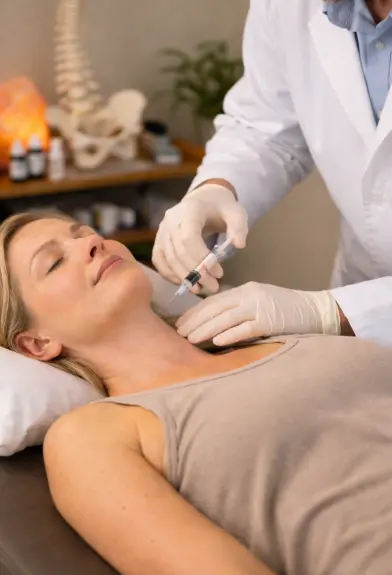
Neural Therapy is the therapeutic use of a small amount of a superficial local anesthetic—most commonly preservative-free procaine—to help create positive changes in the autonomic nervous system for a variety of health conditions.
These injections are most often placed just beneath the skin (similar to a TB skin test) in specific areas such as:
- Scar tissue
- Areas of chronic pain
- Autonomic nerve pathways
- Regions identified through exam and history
The goal is not to “block” pain, but to temporarily interrupt abnormal nerve signaling patterns that may be maintaining inflammation, dysfunction, or persistent symptoms.
When the nervous system shifts out of a protective state and returns toward parasympathetic balance, the body often regains its ability to regulate circulation, immune signaling, muscle tone, and inflammatory response more effectively.
Neural Therapy works with the body’s physiology — not against it — by restoring communication where it has become disrupted.
Neural Therapy works through the autonomic nervous system — but its effects extend to the cellular level.
When the body remains in a prolonged sympathetic (“fight or flight”) state, circulation can become restricted, inflammatory signaling may increase, and mitochondrial energy production can decline. Over time, this environment can perpetuate chronic pain, tension, and delayed tissue repair.
Procaine, the short-acting local anesthetic used in Neural Therapy, temporarily stabilizes nerve cell membranes and interrupts abnormal reflex patterns within the autonomic nervous system. This brief interruption allows dysfunctional signaling loops to reset.
As autonomic balance improves, several physiologic shifts may occur:
- Improved microcirculation and oxygen delivery
- Reduction in neurogenic inflammation
- Decreased peripheral nerve hypersensitivity
- Stabilizing effects on cell membranes
- More efficient mitochondrial energy production
Neural Therapy does not directly “heal” tissue. Instead, it restores the regulatory environment that allows healing to occur naturally.
When the nervous system shifts out of survival mode and back into balance, the body can often resume repair processes that were previously stalled.
Dr. Paul Despres’s interest in reversing chronic pain began at age 12, when he developed sudden joint pain that did not respond to conventional medical treatment. That experience became a defining motivation in his decision to pursue alternative and integrative medicine — with a focus on identifying and addressing root causes rather than simply managing symptoms.
As a physician, Dr. Despres specializes in non-conventional approaches to chronic pain and nervous system regulation. This passion led him to pursue certification in Neural Therapy under Dr. Suzanne Ferree, MD, and Melissa Selby, FNP-C at Vine Medical in Roswell, Georgia.
Dr. Ferree and her team have extensive experience using Neural Therapy to help patients reduce pain and regain functional freedom. Dr. Despres remains in active collaboration with his mentors and colleagues, continuing to refine his skills and contribute to the evolving clinical application of this powerful modality.
Neural Therapy was developed in Germany in the early 20th century by physicians Ferdinand Huneke and Walter Huneke. While experimenting with injections of procaine in the 1920s, they observed that treating certain areas of the body—particularly scars or sites of prior injury—could sometimes produce rapid improvement in symptoms located elsewhere in the body.
Over time, physicians began noticing additional effects beyond temporary pain relief. Early clinical observations suggested that when injured tissues were infiltrated with procaine, healing sometimes occurred more rapidly. For example, fractures and other injuries were reported to recover in significantly less time than expected. These observations led clinicians to suspect that procaine was doing more than numbing tissue—it appeared to influence the autonomic nervous system, particularly the sympathetic nervous system, which plays an important role in circulation, inflammation, and tissue repair.
These findings led to the concept of “interference fields,” where scar tissue or chronically irritated tissue may disrupt normal nervous system signaling. By injecting small amounts of local anesthetic into these areas, Neural Therapy aims to help reset abnormal nerve signaling and restore healthier autonomic regulation.
Today, Neural Therapy is practiced throughout Europe and other parts of the world as a way to support nervous system balance, improve circulation and regulation, and promote the body’s natural healing processes.
Health Benefits
While research is ongoing, published studies and clinical reports suggest potential support in the following areas:
- Antioxidant Support
- May reduce oxidative stress
- Supports cellular repair mechanisms
- Inflammation Regulation
- May help modulate chronic low-grade inflammation
- Supports recovery from injury or surgery
- Brain & Cognitive Function
- May support mental clarity and memory
- Early research suggests potential influence on BDNF and amyloid-beta regulation
- Crosses the blood-brain barrier
- Sleep & Nervous System Regulation
- May support parasympathetic (rest-and-repair) activation
- Reported improvements in sleep quality and emotional resilience
- Cardiovascular & Metabolic Support
- Some studies suggest improvements in endothelial function and metabolic markers
- Post-Viral & Immune Recovery
- Investigated in Long COVID and other inflammatory conditions for symptom support
Neural Therapy is often considered for:
- Any acute or chronic condition with pain (bone, muscular, ligament, tendon, neurological)
- Migraines and chronic headaches
- Post-surgical pain
- Scar-related symptoms
- Digestive dysfunction
- Pelvic pain
- Autonomic dysfunction – dysautonomia, POTS
- Persistent symptoms after injury or illness
It is especially helpful when symptoms persist despite normal imaging or when other treatments have not provided lasting relief.
Neural Therapy is often considered for:
- Any acute or chronic condition with pain (bone, muscular, ligament, tendon, neurological)
- Migraines and chronic headaches
- Post-surgical pain
- Scar-related symptoms
- Digestive dysfunction
- Pelvic pain
- Autonomic dysfunction – dysautonomia, POTS
- Persistent symptoms after injury or illness
It is especially helpful when symptoms persist despite normal imaging or when other treatments have not provided lasting relief.
What to Expect With Treatment
The injection only consists of:
- 1% Procaine – preservative free preferred, but can contain the preservative sodium bisulfate. We NEVER use procaine with benzyl alcohol as it has shown to cytotoxic to nerve tissue.
- Normal saline 0.9% – most often added to dilute the procaine from 2% to 1%
- Sodium Bicarbonate 8.4% – small amount to slightly buffer the injection to make it more tolerable and increase absorption
Most injections are very shallow and quick. Patients may feel:
- A brief sting (from a very small needle)
- Temporary warmth or spreading sensation
- Short-lived numbness in the treated area
Many patients report feeling calmer or more relaxed shortly after treatment. Some experience immediate improvement; others notice gradual change over a series of sessions.
This varies based on:
- Duration of symptoms
- Overall inflammatory load
- Nervous system sensitivity
- Presence of scars or prior trauma
Some patients respond in one session. Chronic or complex cases may benefit from a series of 3-5 treatments spaced 1–2 weeks apart. Some patients get lasting-relief, but only return when their symptoms flare again due to stress, injury, or trauma.
In Neural Therapy, not all local anesthetics are considered equal.
At Aspen Integrative Medical Center, we use procaine specifically because of its unique properties that make it particularly well-suited for autonomic regulation. While anesthetics such as lidocaine or bupivacaine are excellent for many procedures, classical Neural Therapy has favored procaine for nearly a century.
What Makes Procaine Different?
Short-Acting and Regulatory
Procaine has a brief duration of action. In Neural Therapy, the goal is not prolonged numbing — it is a temporary interruption of abnormal nerve signaling. A shorter-acting anesthetic allows the nervous system to reset without extended suppression.
Membrane Stabilization
Procaine temporarily stabilizes nerve cell membranes and modulates sodium channel activity. This brief stabilization may help interrupt dysfunctional autonomic reflex loops that perpetuate pain or inflammation.
Gentle Tissue Profile
When properly diluted, procaine is generally well tolerated and causes minimal local tissue irritation.
Yes. Neural Therapy often enhances the effectiveness of other therapies because regulation improves the body’s responsiveness.
It is commonly combined with:
- IV nutrient therapy
- Ozone therapy
- Regenerative treatments
- Craniosacral therapy and visceral manipulation
- Detoxification protocols
When the nervous system is balanced, other treatments often work more efficiently.
Although Neural Therapy uses a local anesthetic, it is fundamentally different from a traditional nerve block.
A nerve block is typically designed to temporarily numb or shut down a specific nerve in order to reduce pain. The goal is symptom control — often targeting a single anatomical structure.
Neural Therapy, by contrast, is a regulatory treatment.
It uses small, superficial injections of procaine to influence the autonomic nervous system — the system that controls circulation, inflammation, immune balance, and organ function.
The key differences include:
- Depth: Neural Therapy injections are usually very superficial (intradermal), while nerve blocks are often deeper and anatomically targeted.
- Goal: Nerve blocks suppress pain signals. Neural Therapy aims to reset abnormal autonomic signaling patterns.
- Duration of Effect: Nerve blocks work for as long as the anesthetic lasts. Neural Therapy seeks to create a longer-term shift in nervous system regulation.
- Scope: Nerve blocks focus on a specific nerve. Neural Therapy considers broader reflex patterns and the body as an interconnected system.
Neural Therapy is not simply about numbing pain — it is about restoring communication within the nervous system so the body can regulate itself more effectively.
Although the terms are sometimes used interchangeably, a stellate ganglion infiltration performed within neural therapy is different from a conventional stellate ganglion block commonly performed in pain management settings.
A traditional stellate ganglion block is typically performed by a pain management specialist using imaging guidance and deeper needle placement near the stellate ganglion itself. The goal is to create a stronger temporary interruption or “block” of the sympathetic nervous system using anesthetic medications such as lidocaine or bupivacaine. This approach is often utilized in conventional medicine for conditions such as complex regional pain syndrome (CRPS), severe nerve pain, vascular disorders, or PTSD-related symptoms.
In contrast, the stellate ganglion infiltrations performed in neural therapy are generally more superficial and regulatory in nature. Rather than attempting to fully “block” the ganglion, the goal is to gently influence and rebalance autonomic nervous system function through the use of preservative-free procaine and targeted injections into surrounding tissues and fascial planes. The focus is less on creating a dense anesthetic effect and more on helping restore healthy nervous system communication and regulation.
Patients commonly describe neural therapy stellate infiltrations as producing a calming, warming, or relaxing sensation rather than the more profound numbing or sympathetic shutdown associated with a conventional block.
Because neural therapy infiltrations are typically performed more superficially, they may also carry a lower procedural intensity and are often viewed as a gentler approach to autonomic nervous system support.
Safety & Contraindications
Neural Therapy has a long history of efficacy and safety. When performed by a trained provider, Neural Therapy can be a life-changing therapy.
Possible temporary side effects may include:
- Mild soreness at the injection site
- Fatigue
- Brief lightheadedness
- Short-lived emotional release
We carefully evaluate each patient to ensure appropriateness and safety.
1.) Allergy or hypersensitivity to procaine or other ester-type local anesthetics.
2.) Current use of an SNRI medication. This is considered a relative contraindication. Patients taking an SNRI should notify their provider prior to treatment. Temporary modification of dosing may be recommended on a case-by-case basis.
3.) Active infection, cellulitis, or open wound at the intended treatment site.
4.) Uncontrolled bleeding disorders or significant anticoagulant therapy that may increase the risk of bleeding or hematoma formation.
5.) Unstable cardiovascular disease, significant cardiac arrhythmias, or other serious heart conditions (particularly for intravenous procaine administration).
6.) Pregnancy, unless specifically approved by the treating physician after review of potential risks and benefits.
7.) Acute medical emergencies or conditions requiring a higher level of medical care.
Whenever possible, we use preservative-free procaine. In situations where a preservative is present, we ensure it does not contain benzyl alcohol.
Benzyl alcohol has been associated with tissue irritation and is not considered ideal for therapies focused on nervous system regulation. Our goal is to use the cleanest formulation available to support safety and physiologic balance.
For these reasons, Dr. Paul Despres uses procaine thoughtfully and specifically as part of a regulation-based approach to Neural Therapy.
“The intelligent use of the autonomic nervous system will one day become the most important part in the art of healing.”
Dr. Ferdinand Huneke, 1925