




Mild vs. High-Pressure Hyperbaric Oxygen Therapy: Is Higher Pressure Really Better?
One of the most common questions we hear about hyperbaric oxygen therapy (HBOT) is whether a mild hyperbaric chamber is really effective. Many people have been told that HBOT only works at higher pressures—often 2.0 ATA or above—or that soft-sided mild hyperbaric chambers aren’t strong enough to produce meaningful benefits.
The idea that hyperbaric therapy only works at high pressures is outdated.
Research demonstrates that mild hyperbaric therapy at pressures around 1.2–1.3 ATA produces real, measurable biological effects, including effects on stem/progenitor cells, inflammation, cellular signaling, oxygen delivery, cellular metabolism, and recovery.
Higher pressure is not automatically better. Mild and high-pressure HBOT are both active therapies and are better understood as different therapeutic doses for different situations. Higher pressures have an important role for certain acute and medical conditions, while mild HBOT can be particularly useful for chronic and restorative applications.
Bottom line: 1.3 ATA is not a placebo, and it is not “too mild to work.” The growing research on lower-pressure hyperbaric therapy directly challenges that common misconception.
What Does ATA Mean?
Hyperbaric chamber pressure is measured in ATA, or atmospheres absolute. Normal atmospheric pressure at sea level is approximately 1.0 ATA.
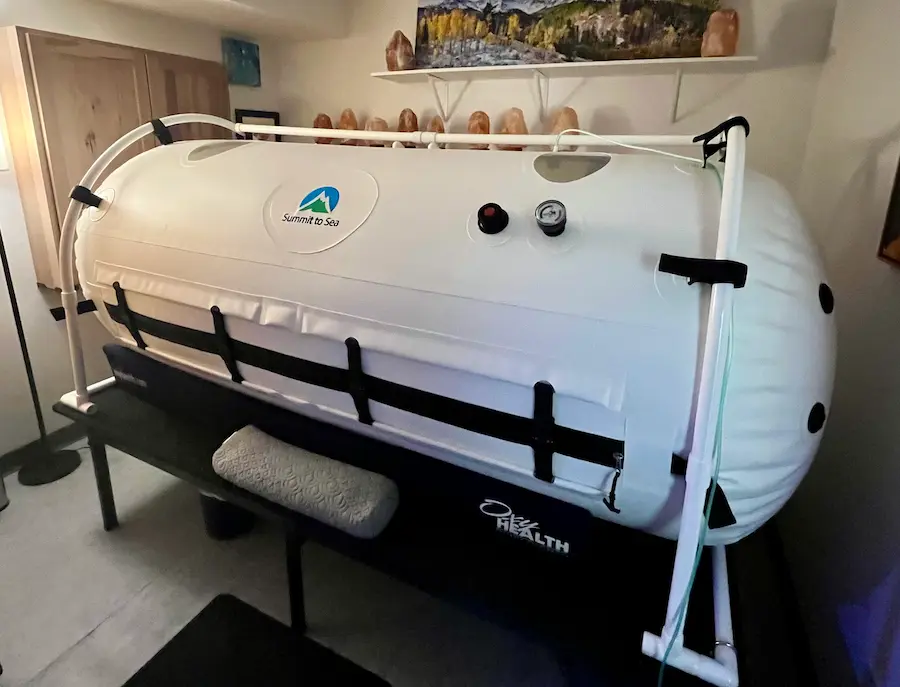
Mild or lower-pressure hyperbaric chambers commonly operate around 1.3–1.5 ATA, while higher-pressure medical chambers may operate at 2.0 ATA or higher. Soft-sided chambers in the United States typically operate around 1.3 ATA, while hard-sided chambers are capable of substantially higher pressures.
Historically, much of hyperbaric medicine developed from diving and undersea medicine, where higher pressures were needed for conditions such as decompression sickness. As a result, much of the early HBOT research naturally focused on higher-pressure treatment.
This history helped create the impression that there is a certain pressure at which HBOT suddenly “starts working.”
Research increasingly suggests that hyperbaric therapy doesn’t function like an on/off switch.
HBOT Is a Dose
The effects of hyperbaric therapy depend on more than chamber pressure alone.
The overall treatment “dose” can involve:
Pressure + oxygen concentration + treatment duration + treatment frequency + total number of treatments
Changing any of these variables changes the treatment.
As with many therapies in medicine, more is not necessarily better. The appropriate dose depends on what we’re trying to accomplish.
Research increasingly shows that HBOT affects cellular signaling and other biological pathways in addition to increasing oxygen availability—and that these effects can occur at pressures considerably lower than traditionally assumed.
1.3 ATA Is Physiologically Active
Perhaps the biggest misconception surrounding mild HBOT is that 1.3 ATA is too low to produce a meaningful physiological effect.
Research does not support that assumption.
In fact, one reason we know this is because pressures around 1.2–1.3 ATA have historically been used as “sham” treatments in some hyperbaric research.
Researchers later recognized a problem: increasing atmospheric pressure by 20–30% isn’t necessarily an inactive placebo.
Research shows that lower pressures can influence growth factors, inflammatory mediators, vasoactive signaling, oxidative signaling, and cellular proliferation.
In one comparison of 2.4 ATA with a supposed “sham” treatment at 1.2–1.3 ATA, the lower-pressure group was still receiving a 20–30% increase in pressure and a substantial increase in plasma oxygen.
This has led researchers to argue that some older HBOT studies may actually have compared two different doses of hyperbaric therapy rather than treatment versus an inactive placebo.
Mild Hyperbaric Therapy Can Mobilize Stem Cells
One particularly interesting human study investigated 1.27 ATA using room air.
Ten healthy adults underwent 90-minute sessions at 1.27 ATA, five days per week, for a total of 10 treatments.
Researchers found that this mild hyperbaric exposure mobilized stem/progenitor cells and altered cytokine signaling. Stem/progenitor-cell mobilization also continued to increase after the exposures ended, suggesting a biological effect that extended beyond the individual chamber session.
The researchers concluded that hyperbaric air itself was likely a therapeutic treatment and suggested that previous research using mild hyperbaric air as a placebo should be reconsidered.
This provides direct human evidence that mild hyperbaric pressure—even without supplemental oxygen—is biologically active.
What About Clinical Outcomes?
The evidence isn’t limited to laboratory markers.
One study involving children with cerebral palsy undergoing intensive rehabilitation compared three hyperbaric protocols:
- 1.3 ATA with room air
- 1.5 ATA with oxygen
- 1.75 ATA with oxygen
All three groups experienced significant improvements, with no significant difference in outcomes between the pressure groups. Importantly, the 1.3 ATA group achieved these improvements using room air rather than supplemental oxygen.
This provides compelling evidence that therapeutic effects can occur without high pressure or high concentrations of oxygen.
It does not mean that 1.3 ATA is equivalent to higher pressures for every medical condition, but it clearly demonstrates that mild hyperbaric therapy can be clinically active.
Other research has demonstrated effects around the 1.25–1.3 ATA range involving exercise recovery, metabolic function, antioxidant activity, sleep, cognition, and other physiological outcomes.
So, Is High-Pressure HBOT Better?
For some conditions, higher pressures are absolutely appropriate and important.
Higher-pressure medical HBOT has an established role in certain acute conditions, including decompression illness and other specific medical indications. In acute injuries, higher-pressure treatment may also provide advantages when it is available.
But that doesn’t mean higher pressure is automatically superior for every patient or every therapeutic goal.
Modern research suggests there may be more overlap in the physiological effects of mild and higher-pressure HBOT than previously thought. It appears mild HBOT may be particularly useful for chronic conditions, while higher pressures may offer advantages for certain acute injuries.
The better question therefore isn’t:
“Which chamber reaches the highest pressure?”
It’s:
“What hyperbaric dose is appropriate for what we’re trying to accomplish?”
What We Use at Aspen Integrative Medical Center
At Aspen Integrative Medical Center, we offer mild hyperbaric oxygen therapy at approximately 1.3 ATA.
We frequently encounter patients who have been told that mild HBOT isn’t strong enough to be beneficial or that only a high-pressure hard chamber provides meaningful therapy.
The research does not support viewing 1.3 ATA as physiologically inactive. Studies have demonstrated meaningful biological and clinical effects at mild hyperbaric pressures.
Mild HBOT doesn’t replace higher-pressure medical HBOT for every condition. Rather, mild and high-pressure HBOT are best understood as different therapeutic doses and different tools, with the appropriate approach depending on the patient and treatment goal.
The Bottom Line
The idea that hyperbaric therapy only becomes beneficial at 2.0 ATA or higher is increasingly difficult to reconcile with the research.
Mild hyperbaric therapy at approximately 1.2–1.3 ATA is biologically active. Human research has demonstrated effects including stem/progenitor cell mobilization, cytokine modulation, and clinical improvements at lower pressures.
Higher-pressure HBOT remains extremely valuable and is particularly important for certain acute and established medical indications. But higher pressure does not automatically mean better therapy.
Mild and high-pressure HBOT should be viewed as different therapeutic doses—not “real HBOT” versus ineffective HBOT.
The goal isn’t simply to maximize pressure. It’s to choose the appropriate hyperbaric dose for the patient and the desired therapeutic effect.
At Aspen Integrative Medical Center, all of our hyperbaric treatments and protocols are physician-supervised by Dr. Paul Despres, ND, our Medical Director. This oversight allows us to evaluate whether HBOT is safe and appropriate for each patient and to individualize treatment based on their specific health concerns, medical history, and response to therapy.
This level of physician oversight and individualized treatment planning is an important part of what sets our hyperbaric program apart from many stand-alone HBOT centers.